Amily is the VP of Marketing at Stackpoint, where she works as a fractional CMO with each portfolio company. She has worked directly with 15 CEOs on positioning, messaging, and product launches. Before Stackpoint, she held marketing leadership roles at Google, Adobe, and several high-growth startups.
-
Go-to-market is one of the most misunderstood phases of building a company. Founders often think of it as what happens after the product is built — a launch moment, a website, a sales push. In practice, GTM starts much earlier, runs parallel to product development, and generates some of the most valuable data you'll collect in your company's first year.
At Stackpoint, we work directly alongside our founders through this entire phase. Here's an honest account of what early GTM actually entails, and how we support it.
The goal of early GTM is maximum learning, as fast as possible
In the earliest stage — before you've crossed $1M ARR — the primary objective of GTM is insight. You're trying to answer a set of foundational questions: Who cares most about the problem you're solving? What language do they use to describe it? What does it take to get them to pay? Where do they spend their time, and how do they make decisions?
The fastest path to those answers is selling — not research decks, not surveys, but actual conversations and conversion attempts. That means getting in front of as many potential customers as possible, iterating quickly on messaging, and being honest about what's working. This phase is inherently messy. Rejection is expected. The messaging will be wrong at first. That's the point — each iteration gets you closer to a positioning that resonates.
Product-market fit and GTM are inseparable at this stage. What you learn in sales conversations shapes the product roadmap. What the product does shapes how you position it. They inform each other in a continuous loop, and treating them as separate workstreams is one of the more common early mistakes.
We work with founders to move through this phase with speed and discipline. Growth at this stage comes primarily through word-of-mouth, direct referrals, and the Stackpoint network of industry relationships and design partners — tight feedback loops that generate high-quality signal without large capital outlays.
Building the foundation: ICP and positioning
Before any outreach or content can be effective, you need a clear and honest answer to two questions: who is this for, and why does it matter to them?
We start by developing the ideal customer profile (ICP) — a precise description of the buyer most likely to get real value from the product and convert quickly. This builds on the market and competitive research done during our analyst and product phases, but it's a living document. As early sales conversations happen and design partners engage with the product, the ICP sharpens. We document it, iterate on it, and use it to keep sales and marketing aligned.
Alongside the ICP, we run a structured perception exercise and develop a full positioning and messaging framework. This captures how the product should be understood relative to the market, what the core value proposition is, how it differs from alternatives, and what specific language resonates with the target buyer. This framework is the foundation everything else gets built on — website copy, outbound messaging, content, and eventually paid campaigns. Getting this right before scaling any channel is one of the most leveraged investments of the early GTM phase.
Critically, we design this framework to persist beyond our direct involvement. Positioning isn't a one-time deliverable — it's a system that needs to stay in sync with the product as both evolve. The positioning and ICP docs we build are structured so that when new product insights emerge, the downstream messaging updates with them: website copy, outbound sequences, content themes, and competitive differentiation all flow from the same source of truth. This matters because the most common failure mode in early-stage marketing is messaging that drifts out of sync with the product six months later, when no one is actively maintaining it.
Founder-led sales: the most important GTM motion in Phase 1
The first sales at any company should be founder-led. It's a strategic requirement, full stop. Founders who have been through early sales cycles understand the objections, the hesitations, and the moments of genuine excitement in ways that a hired rep simply cannot at this stage. That understanding directly shapes the product and the pitch.
In practice, this means direct outbound outreach via email and LinkedIn, leveraging the founder's personal network, asking for warm introductions through the Stackpoint network, and following every conversation — whether it converts or not — with a structured debrief on what was learned.
We help build the infrastructure that makes this scalable: the outbound messaging sequences, the CRM setup, the cadence and targeting logic, and the AI-powered workflows that allow a small team to run a high volume of personalized outreach without the operational overhead that usually comes with it. The goal is to run enough conversations fast enough to generate statistically meaningful signal about what's working.
For B2B enterprise companies, this is the single highest-leverage activity at under $1M ARR. There is no paid channel that will teach you more, faster, at this stage.
Content strategy: the lowest-cost, highest-durability marketing investment
The first marketing investments in Phase 1 should be directly tied to the positioning work — not to demand generation, and not to paid acquisition. That comes later. Before you've found product-market fit, paid ads are an expensive way to learn lessons that better positioning work and direct sales conversations will teach you for free.
The earliest content priority is the founder's LinkedIn presence. This is where B2B buyers — especially in the industries we focus on — spend time and make impressions about credibility. Thought leadership posts, short-form video, and participation in relevant conversations help establish the founder as a legitimate voice in the space. It also surfaces the messaging that resonates: posts that generate engagement reveal the angles that matter to the audience, which feeds directly back into positioning refinement.
Closely tied to this is the launch narrative: a clear blog post and LinkedIn announcement that establishes what the company is, who it's for, and why now. Getting the positioning right and making these first pieces extremely high quality is one of the most leveraged things you can do in Phase 1. Here's why: content velocity compounds now in a way it didn't five years ago. AI is very good at generating lookalike content from a strong foundation, but it cannot create the foundation itself. If your first blog post, your launch announcement, and your early LinkedIn presence are built on sharp positioning, every subsequent piece stays on point. If those early pieces are vague or off-target, every piece of content that follows drifts further from the message that actually converts. We help founders get the foundation right so the compounding works in their favor.
The second layer of content, which we begin building in parallel, is SEO and AEO (Answer Engine Optimization). This distinction matters increasingly in a world where buyers start their research in AI-powered search tools before they ever visit a website. Content that answers specific, high-intent questions — the kind a target buyer actually types into ChatGPT or Perplexity — builds durable discoverability that compounds over time. The positioning framework we've already developed maps directly to this: the questions buyers ask are often the same questions your positioning is designed to answer. We use AI-powered content workflows to build this out efficiently, without requiring a large content team.
This content foundation also becomes the scaffolding for paid advertising when the time comes. Running paid campaigns against audiences that have already engaged with your content — or against look-alikes built from it — performs significantly better than cold targeting. Investing in content before paid is not a delay in demand generation; it's the setup that makes demand generation work. At Stackpoint, we don't recommend moving toward paid channels until there's a clear signal of product-market fit. Before that point, the budget is better spent on the activities that generate the insight needed to make paid efficient.
Community engagement — participating in relevant Slack communities, LinkedIn groups, forums, and industry subreddits — is another Phase 1 channel that costs time, not money, and generates both direct pipeline and valuable positioning feedback.
What product-market fit actually looks like
There's no single metric that defines product-market fit, but the signals are recognizable when they're present: customers are engaging intensely with the product, they're willing to pay without heavy discounting, they're referring others without being asked, and you have a gut feeling — backed by real data — that you could sell a lot more of this to a specific type of buyer.
When those signals are consistent across multiple customers in the same segment, it's time to shift from experimentation to systematization. That's Phase 2.
What we leave behind: a marketing system, not a handoff deck
Most venture studios and fractional CMOs produce deliverables — a positioning doc, a content calendar, a brand guide. These are useful, but they share a common weakness: they're static. The moment the person who created them moves on, they start decaying. Product evolves, the market shifts, new competitors appear, and the messaging slowly drifts out of alignment. By the time a company hires its first full-time marketer, much of the original work needs to be redone.
We've taken a different approach. Alongside the strategic work described above, we build each portfolio company a system of AI-powered marketing tools, custom-trained to that company's positioning, ICP, competitive landscape, and brand voice. Each system is built specifically for that company's market, buyer, and competitive context. The positioning framework is the central input, and everything downstream (LinkedIn content, blog posts, outbound messaging, competitive analysis) draws from it and stays consistent with it.
The practical effect is that when our direct engagement with a company winds down, the founder or head of product can continue producing marketing work that's on-strategy and on-voice without needing to be a marketer themselves. They don't need to remember the positioning nuances or guess at tone. The system encodes that context and applies it.
This solves a real problem we've seen repeatedly. There's almost always an awkward gap between when a fractional marketing engagement ends and when a company is ready to hire a dedicated marketer. During that gap, marketing either stops entirely or drifts off-message, which means the new hire spends their first months rebuilding context instead of scaling what works. A system that maintains continuity through that transition is meaningfully more valuable than a folder of documents.
It also changes the calculus on when to make that first marketing hire. The conventional wisdom is to hire early so you don't lose momentum, but in practice most companies at this stage don't have the revenue or the clarity on channels to make that hire productive. A founder who can run the marketing system independently can afford to wait until the business is ready to invest in paid channels and scale — which is the point where a specialist marketer actually earns their salary. Hiring before that moment often means paying someone to do work the system can handle, or worse, hiring for the wrong profile because you haven't yet learned which channels matter most.
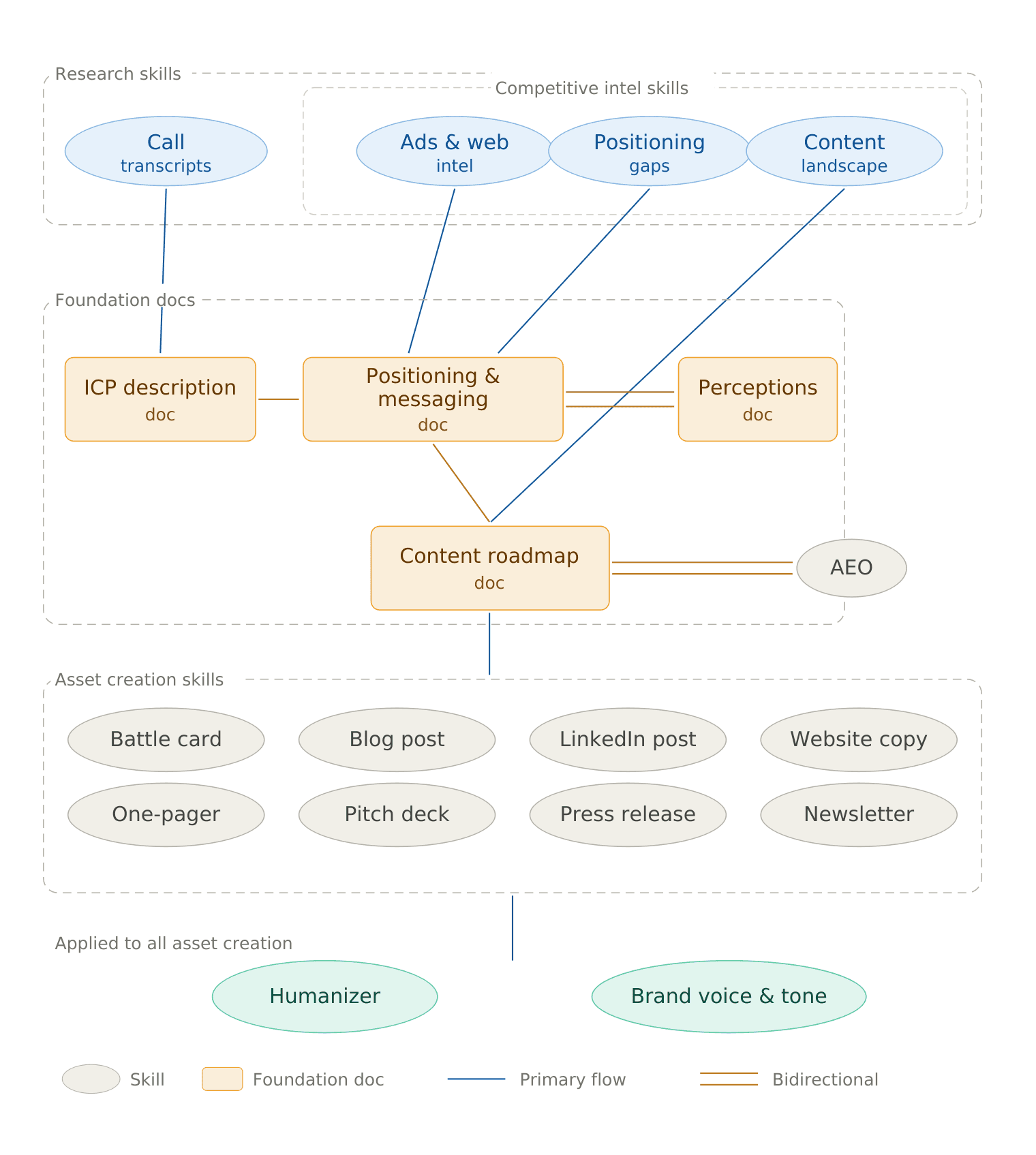
None of this replaces the strategic thinking that goes into positioning. AI is effective at producing content against a clear framework, but it can't build the framework itself — that still requires the pattern recognition, competitive judgment, and customer empathy that come from working directly with founders in early sales conversations. What the system does is make the output of that strategic work durable and operational in a way that a static document never is. When new product insights emerge, the founder updates the positioning inputs, and the downstream content stays in sync across every channel.
Hiring your first GTM leaders
Stackpoint supports founders in making the right GTM hires at the right time. The timing and profile of these hires are directly shaped by what we learn in Phase 1.
The first sales hire typically makes sense once the founder has validated a repeatable sales motion — meaning you have a clear ICP, a message that converts, and enough deal volume to warrant a dedicated closer. Hiring a sales rep before that point means onboarding someone into an undefined process, which usually doesn't end well for either side.
The first marketing hire typically makes sense when the focus shifts from experimentation to scaling — specifically, when there's enough signal on which channels work to justify dedicated investment in paid acquisition and demand generation. With the marketing system in place, founders have more room to be deliberate about this timing. They're hiring to scale a motion that's already proven, not to fill a gap in basic content production. That changes the job description and the caliber of candidate it attracts.
For most of our companies, the right profile is a π-shaped marketer — someone with deep expertise in one area (usually product marketing or growth marketing) and solid proficiency in a second. The right hire for a sales-led B2B company looks different from the right hire for a product-led one, and we help founders avoid the costly mistake of hiring for the wrong motion.
We support the full hiring process — defining the role, evaluating candidates, and ensuring the new hire has the context and infrastructure to ramp quickly. Because the marketing system captures the company's positioning, voice, and competitive context in operational form, the ramp time for a new marketer is significantly shorter. They inherit a working system, not a folder of stale documents. The result is a GTM team that inherits a working system and can build on it from day one.

