Every operator we meet has seen the same demo. Someone on their team types a prompt into Claude or Codex, and a working app appears on the screen in under a minute. The conclusion writes itself: if a weekend prototype can do this much, why are we still paying enterprise software vendors? Why not just have our analyst build it? Or hire a dev shop for a fraction of what a real software team would cost?
It's a fair question, and we hear it from operators every week. The honest answer is that prototyping has never been cheaper, and that's genuinely good news. We use the same tools. We encourage every operator we work with to use them aggressively when they're trying to figure out what to build.
But there is a wide gulf between a working prototype and software that runs your business. Operators who don't see that gulf clearly tend to underestimate it by an order of magnitude, and they pay for the miscalculation later — in a tool nobody trusts, in failed integrations that surface six months in, in a system of record quietly corrupted by a script nobody is maintaining, and in a year of internal effort that produces a worse version of something they could have bought or co-built.
This article is for operators with a real pain point — a workflow that feels like it should be solvable with AI, and isn't being solved well by anything on the market. You are deciding among three paths: build it internally, hire a dev shop to build it for you, or partner with a venture studio like Stackpoint to co-build the company that solves it. We've watched all three play out many times. Here is what we've learned.
1. The Demo Is Five Percent of the Software
The model call — the part of your product that actually uses AI — is the easy part. It was hard three years ago. It is not hard now. Anthropic, OpenAI, and Google have collectively spent tens of billions of dollars making it not hard. That is a gift to everyone building today.
The hard part is everything wrapped around the model call. The integration plumbing that connects the AI to the systems your business actually runs on — your ERP, your CRM, your LOS, your data warehouse, your billing system, your identity provider. The audit trail required for finance, compliance, and the inevitable "why did it do that?" question from your CFO. The retry logic, the fallback paths, the rate limit handling, the version pinning, the eval framework, the cost monitoring, the role-based access controls, and the deployment pipeline that lets someone push a fix at 11pm on a Tuesday without taking your operation offline.
None of that is in the prototype your analyst built. All of it is required for software you can depend on.
The shorthand: the AI is roughly 10% of an enterprise-grade agentic system. The other 90% is the thousands of engineering, design, and product decisions that make it usable, safe, observable, swappable, and improvable. Operators who scope an internal build against the 10% — and budget against the 10% — end up with a tool that demos beautifully and breaks the moment it touches the workflow.
2. Where Vibe Coding Actually Shines (and Where It Doesn't)
We just argued that the AI is 10% of the work. That doesn't mean vibe coding is useless — it means it shines in a specific zone and falls apart outside of it. Knowing where that zone ends is the most important thing an operator can figure out before committing real time and money.
Most takes on this topic are either breathless ("AI will replace your engineering team") or dismissive ("it's a toy"). Neither is right, and neither helps you make a good decision. The pragmatic answer depends on two questions, not one:
Who is going to use this thing? Just you, or other people — teammates, customers, or partners?
What happens if it's wrong? If it breaks, misfires, or hallucinates — is it a shrug, or does something real go sideways?
Plot those two questions as axes, and you get a 2x2 that tells you almost everything you need to know about whether vibe coding is the right tool for your job.
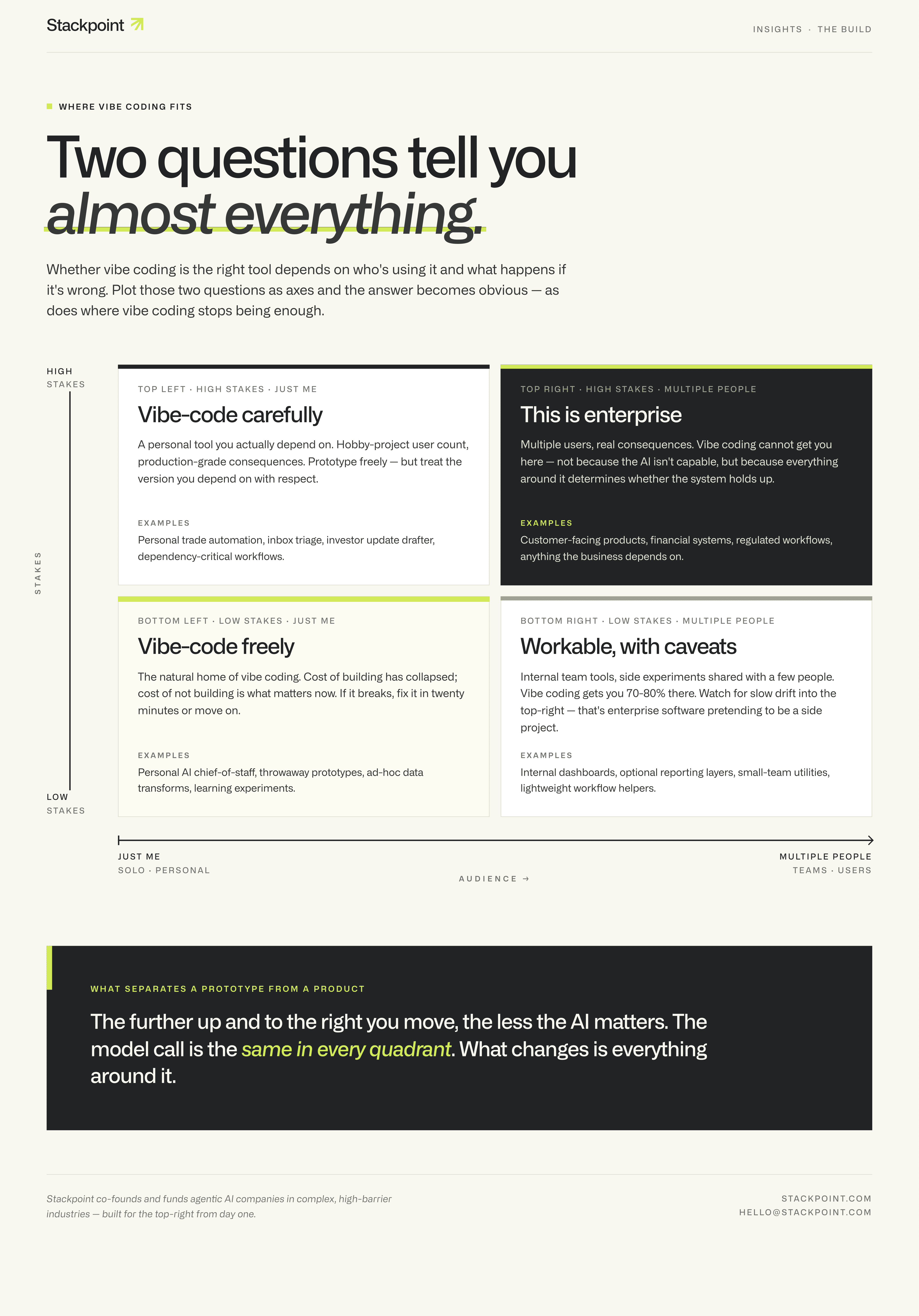
Bottom-left — Just me, low stakes
Vibe coding's natural home, and genuinely powerful here. A personal AI chief-of-staff that pulls your calendar, email, and CRM into a morning brief. A script that reformats your weekly board update. A throwaway prototype to see whether a workflow is even worth pursuing. An ad-hoc data transformation. A learning exercise. Ship it. Don't overthink it. If it breaks, fix it in twenty minutes or move on. The cost of building has collapsed; the cost of not building is what matters now.
Top-left — Just me, high stakes
Trickier. A personal tool you actually depend on — a script that manages your inbox triage, automates trades in a personal account, drafts your investor updates — has the user-count of a hobby project but the consequence profile of production software. Vibe-code the prototype, by all means. But if you're going to depend on it, treat the production version with respect: error handling, sanity checks, the ability to undo. Personal-but-important is the quadrant most operators think they're in when they're actually in the top-right.
Bottom-right — Multi-user, low stakes
Workable, with caveats. Internal team tools where three to five people use a dashboard. Side experiments shared with a small group. Optional reporting layers. Vibe coding can get you 70-80% of the way here. The 20% gap is mostly UX consistency, edge cases when multiple people use it simultaneously, and the inevitable feature creep when "the team likes it." If it stays low-stakes, this quadrant is fine. The risk is that it slowly drifts into the top-right without anyone noticing — and then it's enterprise software pretending to be a side project.
Top-right — Multi-user, high stakes
Enterprise. Customer-facing software. Financial systems. Regulated workflows. Software that attempts to replace labor. Anything multiple people depend on where being wrong has consequences — for customers, for revenue, for compliance, for the business itself. Vibe coding cannot get you here. Not because the AI isn't capable — it is — but because everything around the AI is what determines whether the system holds up. This is the quadrant the rest of this piece is about.
The diagonal is the key insight
The further up and to the right you move, the less the AI matters and the more the engineering and design discipline does. The model call is the same call. What changes is what surrounds it.
3. What Becomes Required as You Move Up and to the Right
The natural follow-up question is: what specifically? What does a personal AI chief-of-staff get away with not having, that a customer-facing enterprise system absolutely requires?
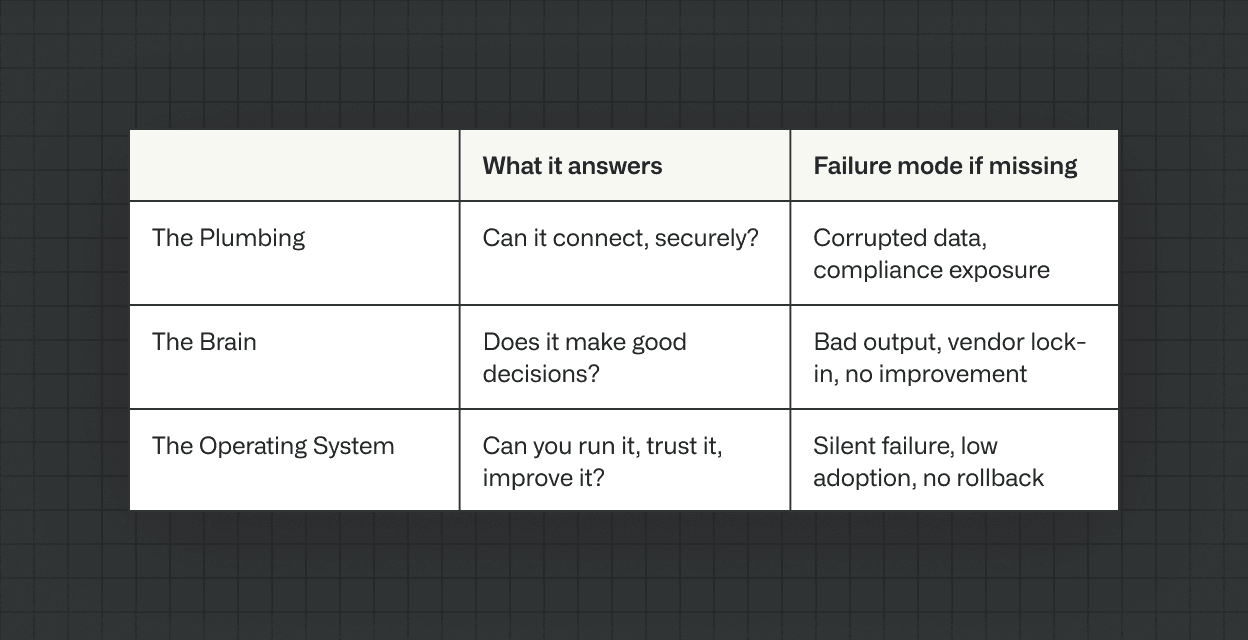
It is not one thing. It is thirteen things, falling into three buckets. Each bucket answers a different question. Each fails in a different way. As you move from bottom-left to top-right, they don't become nice to have — they become the difference between software you can depend on and software that quietly breaks your business.
When we architect a Stackpoint company, we plan for all thirteen from day one. Most internal teams plan for three or four. The ones they miss are the ones that surface twelve months in — when the workflow has been live just long enough that the business now depends on it, and there's no path back.
Bucket 1: The Plumbing — Can it connect, securely?
The layers that move data in and out of the system and keep it safe along the way:
Data foundation — clean schemas, reliable read and write paths to your systems of record, and the validation, transaction, and rollback logic that prevents your software from corrupting the database your business runs on.
Integration layer — robust APIs to every system the agent touches, with real auth, retry logic, rate limiting, and graceful degradation when upstream systems are slow or down. They will be, often.
Authentication and authorization — SSO integration, role-based permissions, and per-action access controls. Who can see customer credit data, who can approve agent-generated invoices, who can change configurations.
Security and compliance — encryption in transit and at rest, secrets management, vendor risk controls, PII protection, and data residency. Designed in from day one, not bolted on later.
If this bucket is wrong, you corrupt source data, leak PII, or fail compliance review. Nothing else matters until this is solid.
Bucket 2: The Brain — Does it make good decisions?
The layers that determine how the agent thinks, acts, and improves:
Model abstraction and selection — so your product isn't hard-wired to one provider, and so each stage of the workflow runs on the right model for the job. Frontier models for hard reasoning, fine-tuned small language models for domain- and task-optimized work, and open-weight models where data sensitivity or cost requires it. The right model for the right stage, with the architecture to swap when something better ships.
Agent orchestration — the logic that decides what the agent does, in what order, with what tools, and when to escalate to a human. Includes the guardrails on what the agent can act on autonomously versus what requires approval.
Business logic and rules engine — your operating rules (what's a valid PO, who can approve a price override, when does a quote expire) encoded so the agent enforces them consistently across users, branches, and edge cases.
Evaluation and continuous improvement — ongoing measurement of agent accuracy, cost, and business outcomes. Regression testing when prompts, models, or logic change. The system gets measurably better over time, not just more expensive.
If this bucket is wrong, the agent makes inconsistent or expensive decisions, gets stuck on one provider, or quietly degrades over time. This is where internal builds often fall short.
Bucket 3: The Operating System — Can you run it, trust it, and improve it?
The layers that make the system usable, observable, and durable in production:
Human-in-the-loop workflows — clear interfaces for humans to review, approve, override, and correct agent actions. The agent learns from corrections. Humans always have visibility and final authority on consequential decisions.
Audit, logging, and observability — every agent action logged: what it did, why, which model produced the output, who approved it. Dashboards showing system health, transaction volume, error rates, and cost per task. Required for finance, compliance, debugging, and trust.
Error handling and monitoring — graceful failures, alerts to the right people, automatic retries on transient errors, and clear escalation when the agent can't resolve something. The system tells you when it's struggling instead of failing silently.
Deployment, versioning, and rollback — code and configuration changes deployed safely, with the ability to roll back fast when something breaks. Staging environments that mirror production. Zero-downtime updates.
User experience and change management — interfaces designed for the actual humans who'll use them, training, documentation, support, and feedback loops to drive adoption.
If this bucket is wrong, the system either fails silently in production or nobody trusts it enough to use it. Where most prototypes die when they try to scale — and where vibe-coded MVPs are weakest by an order of magnitude.
None of this is glamorous. All of it is non-negotiable for software you intend to depend on.
4. Why the Model Layer Deserves Its Own Section
Of the thirteen layers, this is the one we single out — because it is the most commonly skipped, and the most expensive to retrofit.
The AI model market is the most volatile layer of the entire stack. New models ship every few weeks. Prices drop in step-function moves. Capabilities shift. The best model for your hardest task today will likely not be the best model in six months — and there is a meaningful chance it won't even be the cheapest model for the same accuracy in three.
But volatility is only half the story. The other half is that not every task needs your best model. A properly architected system applies the right model to the right stage of the workflow. Hard reasoning and ambiguous judgment calls may run on frontier models. Narrow, high-volume tasks — classification, extraction, routing, structured output generation — often run faster, cheaper, and more accurately on fine-tuned small language models. Sensitive workflows may run on open-weight models hosted in operator-controlled environments. Each stage gets the model that fits it.
Internal teams and dev shops typically hard-wire their build to one provider's API — usually whichever one the prototype was built on. The cost shows up in four places. You miss the upgrade curve every time a better model ships. You overpay on tasks that should run on cheaper, faster, smaller models. You can't route data-sensitive workflows to environments your customers require. And you carry vendor risk that compounds quietly until the day it doesn't.
A properly architected system talks to a generic AI interface, routes different tasks to different models based on cost, accuracy, latency, and data sensitivity, runs continuous evals on real data to compare alternatives, and treats the model layer as a swappable component rather than a load-bearing wall. Teams who build this right get to surf the price-performance curve as it improves — and to right-size every task to the model that fits it. Teams who don't get to watch competitors who did.
This is not theoretical. We've watched portcos cut a meaningful share of their inference cost in a single quarter by routing a previously model-locked workflow through a cheaper, smaller model that turned out to be equally accurate. The savings flowed straight to operating margin. It was possible because the architecture was designed for it from day one.
5. Why a Startup Beats a Dev Shop
So far the argument has been about what enterprise-grade agentic AI requires. The natural follow-up: can't I just hand the spec to a dev shop and have them build it?
The answer is no — but not for the reason you might think. The reason is not that dev shops can't write good code. The best ones can. The reason is structural: a dev shop and a venture-backed startup company building AI-native software for your market are built to optimize for different things, and those differences compound across the life of the product. Three differences matter most.
The alignment problem. A dev shop is a service business. It is paid by the contract — it succeeds when it ships on spec, on time, on budget. Everything in its operating model is built around that. This is not a flaw; it is what a service business is. But a well-built startup operates on a different existential equation: it succeeds only if the product actually works in market, sustainably, for years. If the product doesn't deliver durable value to real customers, the startup dies. That dependency — equity value that exists only if the product keeps solving problems — is the strongest possible alignment with the operator's long-term interest. Stronger than any service agreement. It rewires every decision: what to build first, what to defer, what to throw away, when to push back on the operator, when to rebuild rather than patch.
The AI trap. AI has made it dramatically faster to write code. It has not made it faster to think. The risk for any team building agentic systems right now is not that the code is hard to produce — it is that AI lets you confidently build the wrong thing faster than ever. A dev shop tends to use AI as a cost lever on delivery, which sharpens the trap: more code, faster, against requirements that may not have been the right requirements in the first place. A startup uses AI differently — to compress product discovery, pressure-test architectural decisions, simulate workflows, and stress-test edge cases before they become production incidents. Same tool, opposite incentive. The startup's survival depends on shipping the right thing, not just shipping.
The embedded advantage. Enterprise workflows are not static. Requirements evolve continuously as the operator learns, the market shifts, regulations change, and the AI itself improves. A dev shop is built to leave when the contract ends; anything after that is a change order, billed by the hour, against a specification you have to write. A startup is built to stay — to absorb feedback in real time, to ship iteratively against an evolving understanding of the workflow, to share ownership of the problem definition with the operator over years. The product gets better continuously because the team building it is still in the room, still learning from customers, still pressured by the market to keep innovating. With a dev shop, the product is frozen at the moment the contract closes, and every subsequent improvement is a transaction.
There is also a talent layer beneath these three. Dev shops compete on cost-per-hour against other service businesses. Top AI engineers are not generally available in that market — they are at frontier labs, at well-funded startups, or at companies whose equity can produce life-changing outcomes. A well-capitalized AI-native startup is structurally built to attract and retain that talent: equity upside, mission, ownership over real product surface area, and the kind of technical problems that draw senior engineers. Over a five-year horizon, a tool built by lesser talent on a contract basis against a frozen spec cannot outpace a product built by top talent under continuous market pressure.
Finally, the operator's own burden is different. Hiring a dev shop means owning vendor management — managing an external team you didn't build, did not select, and are not equipped to QA on the substance of agentic systems. It means subsidizing every future enhancement, every maintenance cycle, every security patch, in perpetuity, on a contract basis. For most operators, all of that lives outside core competency. Partnering with a startup shifts that burden to a team built to carry it — and a team for whom carrying it well is the entire business.
None of this is a knock on dev shops. They are excellent at what they are built for — execution against a clear spec, in a domain where the spec is stable. Agentic AI in real enterprise workflows is not that domain. The shape of the workflow, the model layer, the integration surface, and the operating model are all evolving simultaneously. The company best positioned to navigate that evolution is the one whose existence depends on getting it right.
6. The Design Partner Path
So: assuming you're convinced the right path is partnering with a startup building for your industry rather than hiring a dev shop, the question becomes how that relationship actually works.
For most operators, the answer is to partner — early and deeply — with the team building the right solution for your market, before the product exists in its finished form. A design partner relationship done well is one of the highest-leverage moves an operator can make. You get a product purpose-built around your workflow, because you are the first customer shaping it. You get preferred pricing and co-investment opportunities that reflect the value of your collaboration. You get a seat at the table on the roadmap. And — critically — you get all of this without owning the engineering team, the maintenance burden, or the architectural risk of building it yourself.
This is the model we run at Stackpoint. We co-found roughly four agentic AI companies per year in high-barrier industries, and we embed alongside operator design partners during the formative phase — when the architecture, workflow design, and early customer reality are getting locked in. The startups we incubate provide the workflow depth, the technical foundation, and the long-term ownership. The operator design partners provide the workflow expertise, the data access, and the ground-truth validation that make the product actually work. In return, those design partners get a system designed around their reality — not retrofitted to it — and economic terms that reflect the contribution.
We've written separately about how that exchange works. The short version: an operator's intangible assets — workflow expertise, proprietary data, customer relationships, operating context — are dramatically more valuable inside a venture being built around them than they are sitting unused on a balance sheet.
7. The Bottom Line
If your goal is to ship an internal prototype, prove a workflow concept, or build a feature inside an existing tool, you do not need a venture studio. Vibe-code it. Move fast. Most of those projects will and should be throwaways, and the cost of building them has collapsed.
If your goal is to depend on it — to put workflow, money, customers, or compliance exposure on top of it — the math is different. The 90% of the work that is not the AI is still 90% of the work. The architectural decisions made in the first six months will compound, for you or against you, for the next five years. The vendor lock-in accepted on a Tuesday in month two will cost a quarter of operating margin in year three. The audit trail skipped in the MVP will block the next phase of rollout.
The cheapest builds are not the ones with the lowest day-one cost. They are the ones that don't need to be rebuilt.
We've seen both paths play out many times. The operator who vibe-codes an internal MVP, hands it to a dev shop to "productionize," and rebuilds the entire system eighteen months later — having absorbed all the cost, all the risk, and none of the upside. And the operator who partners with a startup building for their market as a design partner, helps shape the company being built around their workflow, and ends up with a better product, equity in the venture, and none of the architectural risk on their balance sheet.
Both paths exist. Both are legitimate. The expensive mistake isn't picking the wrong one — it's not realizing which one you picked until the rebuild.
Stackpoint is a venture studio that co-founds and funds agentic AI companies in complex, high-barrier industries. We launch and invest in four companies per year, always alongside operator design partners who help shape the product from day one. If you have a workflow that feels like it should be solvable with AI — and you're trying to figure out the right path forward — we'd love to talk.
Companion piece: The 95% Problem reaches the same conclusion from the other side — the 2025–2026 market data (MIT, Gartner, Forrester, and others) on why AI pilots stall, and what the ones that work have in common. This piece reasons it out from first principles; that one shows the reports landing in the same place.

